
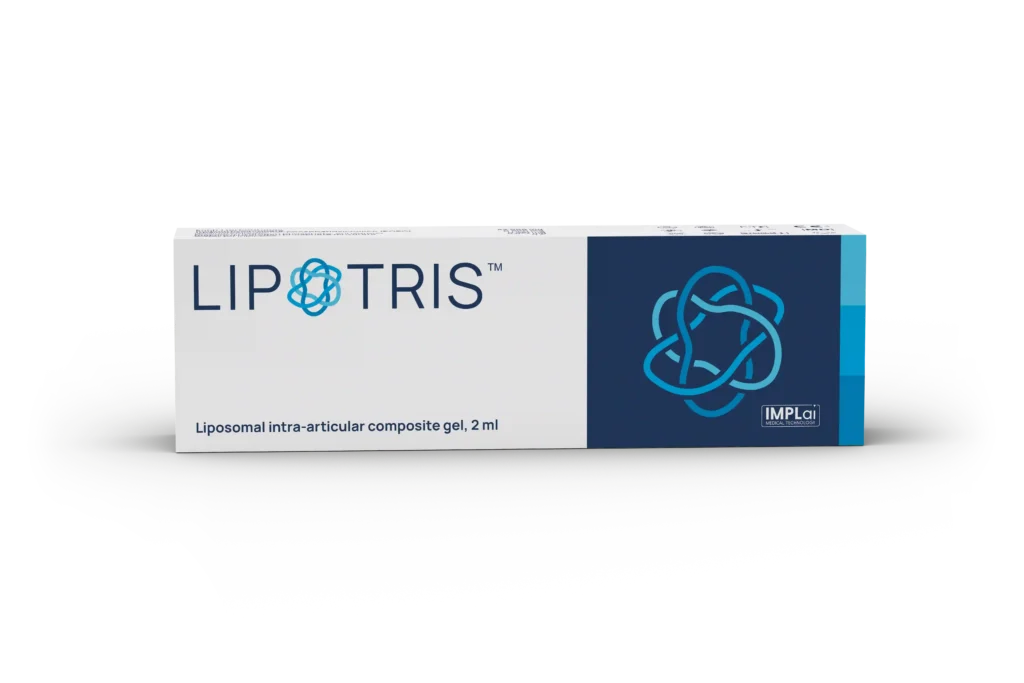
How the combination of hyaluronic acid and liposomes provides a fundamentally different mechanism of action — and what recent clinical data show.
Intra-articular injections with hyaluronic acid (HA) have been part of the standard repertoire for knee osteoarthritis for decades. Yet, a recurring frustration is heard in literature and clinical practice: the effect is limited in time, varies per patient, and the precise duration of action varies greatly. A new preparation, Lipotris™ — a liposomal composite gel with HA — offers a mechanistically distinct approach that goes beyond classic viscosupplementation. A recently published prospective study in the Journal of Cartilage & Joint Preservation (Bąkowski et al., 2026) supports both the mechanical properties and the clinical outcomes.
The problem: joint lubrication theory as an underestimated factor
In osteoarthritis, it is not just cartilage that is lost — the joint capsule hardens, the synovial fluid loses its viscoelastic properties, and the coefficient of friction in the joint increases significantly. This leads to a vicious cycle: more friction → more mechanical stress → more inflammation → further cartilage loss.
Classic hyaluronic acid works primarily as a viscosupplement: it temporarily increases the viscosity of the synovial fluid. As soon as the HA is broken down by hyaluronidases (within 2–4 weeks), this effect disappears. Lipotris™ introduces a fundamentally different concept: the “tribosupplement”.
Mechanism of action: from sliding to rolling
The role of liposomes
Lipotris Assembly Process
The core mechanism: liposomes actively interact with lubricin molecules (SUPERFICIAL ZONE PROTEIN) on the cartilage surface. Through this interaction, they transform the movement in the joint from a sliding to a rolling motion — a fundamental difference that reduces the coefficient of friction (µ) to near-zero levels (< 0.001). For comparison: classic HA achieves µ-values of 0.02–0.05.
Synergy with hyaluronic acid
The HA component (44 mg per 2 mL, 3 injections equal one treatment, thus 132 mg per 6 mL) plays a complementary role: it provides the viscoelastic framework that keeps the liposomes in suspension and ensures the biological effects that have long been known — CD44 receptor activation, inhibition of pro-inflammatory cytokines (IL-1β, TNF-α), and stimulation of endogenous HA production by synoviocytes.
The combination of both components results in an effect described by the manufacturer — and now also in literature — as “active tribosupplementation”: not merely lubrication as a passive mechanical consequence, but active improvement of movement quality at the molecular level.
| ▶ KEY POINT
Lipotris™ combines the biological effects of hyaluronic acid with the tribological properties of liposomes. While HA provides anti-inflammatory effects and stimulates endogenous HA production, the liposomes reduce the coefficient of friction to near-zero — an effect that cannot be achieved with HA alone. |
New study (2026): mechanical and clinical validation
The most recent publication on Lipotris™ appeared in early 2026 in the Journal of Cartilage & Joint Preservation: Bąkowski et al. present a single-arm prospective study evaluating both the mechanical and physicochemical properties as well as the clinical outcomes.
Study design
- Single-arm prospective study in patients with symptomatic knee osteoarthritis
- Protocol: 3 intra-articular injections of Lipotris™ with a 7-day interval
- Evaluation of tribological properties (rheological measurements, friction tests) and clinical outcomes
- Follow-up up to 2 years, with interim evaluations at 2, 6, 14, and 28 weeks
Mechanical and physicochemical findings
In-vitro rheological analyses confirm that the composite gel exhibits significantly higher viscoelasticity than HA monogels, and that the coefficient of friction under low load (physiological regime) is drastically lower. The interaction with lubricin molecules on the cartilage surface was morphologically documented in the study via AFM analyses.
Clinical outcomes: pain and functionality over time
Patients reported a significant improvement in pain (VAS) and functionality (WOMAC) as early as 2 weeks after the first injection. The clinical effect then progressively increased during follow-up, with the lowest pain level at 28 weeks, and remained significantly improved compared to baseline at 2 years. The total WOMAC score decreased by over 70% during this period. The table below shows this progression.
| Measurement moment | VAS pain score | Total WOMAC score |
| Baseline | 5.5 ±1.4 | 37.8 ±19.5 |
| 2 weeks (after 1st injection) |
3.8 ±1.9 p=0.002 |
— |
| 28 weeks (lowest level) |
2.0 ±1.5 p<0.001 |
— |
| 2 years | 2.5 ±1.9 p<0.0001 |
10.4 ±12.9 p<0.0001 (reduction >70%) |
| ▶ KEY FIGURE In 80% of patients, clinically meaningful pain relief was still achieved at 2 years (based on anchor-based threshold values). Notably: the effect occurred faster than with conventional HA preparations — a fact that corresponds with the expected mechanism of action, as the direct tribological action requires no accumulation period. |
The authors conclude that Lipotris™ “offers rapid and sustainable improvement both mechanically and clinically in patients with knee osteoarthritis, demonstrable up to 2 years after treatment”, and position the product as a promising addition to the therapeutic arsenal alongside — and complementary to — existing biological treatments.
OARSI 2024: confirmation from independent research
Already at the OARSI 2024 congress, Bąkowski and Madej presented an abstract with similar findings: the liposomal intra-articular gel “provides components for ultra-low friction in the synovial joint and thereby improves clinical and functional outcomes in patients with osteoarthritis.”
This underscores the consistency of the findings: the mechanism is reproducible and its clinical translation is robust, regardless of the study design.
Lipotris™ vs. classic hyaluronic acid: key differences
| Feature | Classic HA | Lipotris™ |
| Primary mechanism | Viscosupplementation (passive) | Tribosupplementation (active) |
| Coefficient of friction (µ) | 0.02–0.05 | < 0.001 |
| Interaction with lubricin | Indirect / limited | Direct / demonstrable |
| Onset of effect | 4–8 weeks | From 14 days |
| Duration of action | 3–6 (12) months | ≥ 2 years |
| CD44 activation | Yes | Yes (via HA component) |
| Injection schedule | 1–3 injections | 3 injections (7-day interval) |
Practical application
Indications
Lipotris™ is indicated for symptomatic knee osteoarthritis (Kellgren-Lawrence grade I–III) in patients with insufficient response to conservative treatment. The product is particularly suitable for active patients who desire rapid functional recovery, and as an alternative for patients in whom classic HA was insufficient or too short-lived.
Treatment protocol
- 3 intra-articular injections of 2 mL each
- Ultrasound- or fluoroscopically guided injection recommended for optimal placement
- Clinical evaluation recommended on day 14, 6 weeks, 6 months, and 1-2 years
Combination therapy
The combination of Lipotris™ with a supervised rehabilitation program (e.g., GLA:D® or equivalent) enhances the effect: optimized joint lubrication creates a therapeutic window of reduced pain within which muscle-strengthening exercises are better tolerated.
| ▶ CLINICAL ADVICE
Consider Lipotris™ specifically for patients who (1) previously had insufficient benefit from conventional HA, (2) desire a rapid onset of pain relief, or (3) have an active movement profile where low-friction joint protection is clinically relevant. |
Conclusion
Lipotris™ represents a mechanistically different approach to viscosupplementation in knee osteoarthritis. Through the synergy between hyaluronic acid and POPC liposomes, qualitatively better joint lubrication is achieved — with a faster onset, a demonstrably lower coefficient of friction, and clinically relevant effects that last for at least 2 years.
The recent prospective study by Bąkowski et al. (2026) provides both mechanistic support and clinical evidence. For the specialist who wants to expand their therapeutic arsenal with an evidence-based, biologically rational option, Lipotris™ is a relevant addition.
References
- Paweł Bąkowski, Piotr Bełdowski, Jakub Kaszyński, Kamilla Grzywacz Bąkowska-Żywicka, Przemysław Krakowski, Tomasz Piontek, Theodorakys Marín Fermín; Liposomal composite gel for knee osteoarthritis: mechanical and physicochemical properties assessment and clinical outcomes of a single-arm prospective study; https://doi.org/10.1016/j.jcjp.2026.100321 link: https://www.cartilagejournal.org/article/S2667-2545(26)00038-7/fulltext
- Bakowski, P., & Madej, W. (2024). Liposomal intra-articular gel provides components for ultra-low friction in the synovial joint, thus improving clinical and functional outcomes of patients with osteoarthritis. Osteoarthritis and Cartilage, 32, S45-S46. Link: https://www.oarsijournal.com/article/S1063-4584(24)00114-6/fulltext
- Lin W, Mashiah R, Seror J, Kadar A, Dolkart O, Pritsch T, Goldberg R, Klein J. Lipid-hyaluronan synergy strongly reduces intrasynovial tissue boundary friction. Acta Biomater. 2019;83:314-321. doi: 10.1016/j.actbio.2018.11.015.
- Petelska AD, Kazimierska-Drobny K, Janicka K, Majewski T, Urbaniak W. Understanding the Unique Role of Phospholipids in the Lubrication of Natural Joints: An Interfacial Tension Study. Coatings 2019;9(4):264. https://doi.org/10.3390/coatings9040264
- www.lipotris.com
Supportho Medical


